10 AI Skills That Will Stay Valuable Beyond 2026 (And How to Start Learning Them)
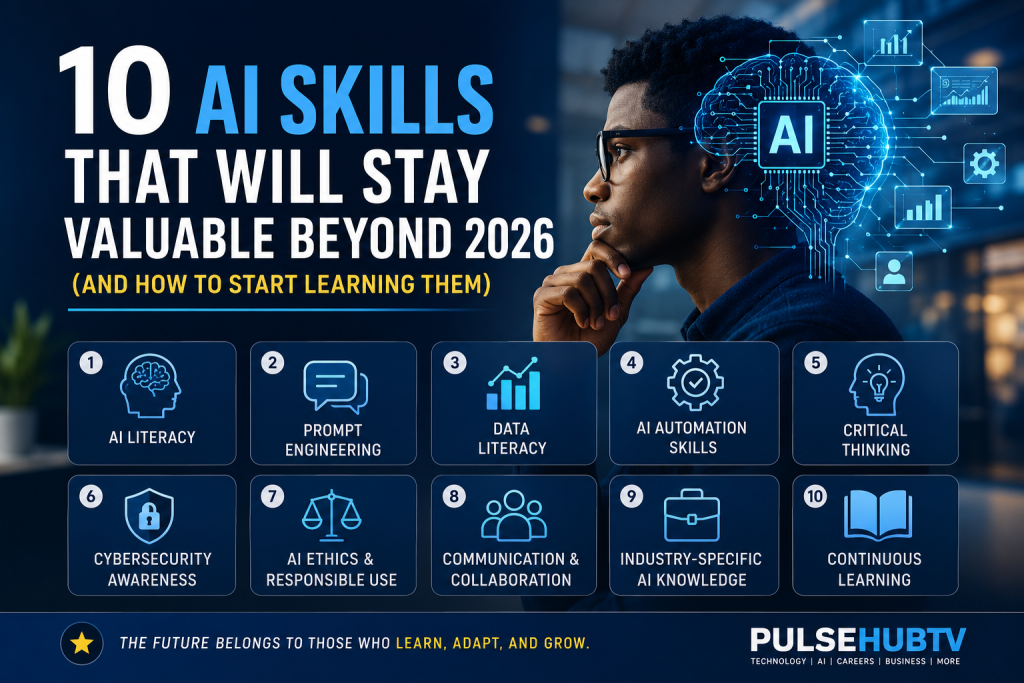
Editorial Note: Artificial intelligence is evolving rapidly, but not every AI skill has the same long-term value. This guide focuses on practical, transferable skills that are expected to remain relevant across industries beyond 2026. Our recommendations are based on current AI adoption trends, workforce demand, and established industry practices. Readers should continue learning as AI technologies and employer requirements evolve.
📌 Key Takeaways
- Artificial intelligence is creating new career opportunities across multiple industries.
- Technical skills alone are no longer enough—critical thinking and AI literacy are equally important.
- You don’t need a computer science degree to begin learning many valuable AI skills.
- Combining AI knowledge with your existing profession can significantly improve career opportunities.
- Continuous learning is one of the most valuable skills in the AI era.
Who Is This Guide For?
This article is designed for:
- Students preparing for future careers.
- Professionals who want to remain competitive.
- Freelancers looking to expand their services.
- Business owners interested in AI adoption.
- Anyone curious about learning artificial intelligence.
Table of Contents
- ⭐ PulseHubTV Quick Recommendation
- Introduction
- Why AI Skills Matter Beyond 2026
- 1. AI Literacy
- 2. Prompt Engineering
⭐ PulseHubTV Quick Recommendation
Don’t try to learn every AI tool. Instead, build strong foundational skills such as AI literacy, prompt writing, critical thinking, and problem-solving. These abilities remain valuable even as specific AI platforms continue to change.
Introduction
Artificial intelligence is transforming the way people work, learn, and solve problems. From healthcare and finance to education, cybersecurity, marketing, and software development, AI is becoming part of everyday workflows across nearly every industry.
As AI adoption continues to grow, employers are looking for people who understand how to work effectively with these technologies—not simply those who can use one popular AI tool. The ability to adapt, learn continuously, and apply AI responsibly is becoming an increasingly valuable career advantage.
The good news is that learning AI doesn’t always require advanced programming knowledge. Many of today’s most valuable AI skills can be developed gradually through practice, curiosity, and consistent learning.
Whether you’re a student, job seeker, freelancer, entrepreneur, or experienced professional, investing in the right AI skills today can help prepare you for future opportunities.
If you’re interested in how artificial intelligence is already influencing employment, you may also find these PulseHubTV guides useful:
Why AI Skills Matter Beyond 2026
Artificial intelligence is unlikely to replace every job, but it is changing how many jobs are performed. Professionals who understand how to collaborate with AI systems may become more productive, make better decisions, and adapt more quickly to workplace changes.
Rather than viewing AI as a threat, many experts encourage workers to see it as a tool that can enhance creativity, automate repetitive tasks, and support better decision-making.
💡 PulseHubTV Insight
The most successful professionals of the future are likely to combine human strengths—such as creativity, communication, ethical judgment, and critical thinking—with AI-powered tools instead of competing against them.
1. AI Literacy
AI literacy means understanding what artificial intelligence can and cannot do. You don’t need to become a machine learning engineer, but you should understand common AI concepts, basic terminology, ethical considerations, and how AI is being applied in different industries.
Developing AI literacy helps you evaluate AI-generated information more critically and use AI tools more effectively in your daily work.
For example, small business owners can explore practical applications in our guide:
👉 How Small Businesses Are Using AI in 2026
2. Prompt Engineering
Prompt engineering is the ability to communicate effectively with AI systems by writing clear, structured instructions. Better prompts often produce more accurate, useful, and relevant responses.
This skill is becoming valuable across content creation, marketing, customer support, education, software development, research, and many other fields.
Learning prompt engineering isn’t about memorizing prompts—it’s about understanding how to ask better questions, provide context, and refine AI outputs.
⭐ PulseHubTV Pro Tip
Practice using AI as a collaborative assistant rather than expecting perfect answers. Review every response, verify important information, and improve your prompts through experimentation.
3. Data Literacy
Artificial intelligence relies on data to identify patterns and generate insights. While you don’t need to become a data scientist, understanding how data is collected, interpreted, and used will help you make better decisions when working with AI tools.
Data literacy includes:
- Reading charts and reports accurately.
- Understanding basic statistics.
- Recognizing unreliable or misleading information.
- Making informed decisions using data.
Professionals who combine AI with strong data literacy are often better equipped to solve business problems and communicate insights effectively.
4. AI Automation Skills
Automation is one of AI’s biggest advantages. Learning how AI can automate repetitive tasks can improve productivity and allow you to focus on higher-value work.
Examples include:
- Automating emails.
- Generating reports.
- Scheduling tasks.
- Customer support chatbots.
- Content drafting.
- Workflow automation.
⭐ PulseHubTV Pro Tip
Start by automating one repetitive task in your daily workflow. Small improvements can save significant time over weeks and months.
5. Critical Thinking
AI systems can produce impressive results, but they can also make mistakes or generate inaccurate information. Critical thinking helps you evaluate AI-generated content instead of accepting every response as correct.
Ask questions such as:
- Is this information supported by reliable evidence?
- Does the response make logical sense?
- Should I verify this using trusted sources?
Employers increasingly value people who can combine AI efficiency with sound human judgment.
6. Cybersecurity Awareness
As AI becomes more integrated into business operations, cybersecurity awareness is becoming an essential skill. Understanding safe online practices helps protect sensitive information and reduces the risk of cyber threats.
Important topics include:
- Recognizing phishing attempts.
- Protecting personal and business data.
- Using strong passwords and multi-factor authentication.
- Understanding AI-related security risks.
To learn more, explore our detailed guide:
👉
AI and Cybersecurity in 2026
7. AI Ethics and Responsible Use
Responsible AI use is becoming increasingly important as organizations adopt AI technologies. Professionals should understand issues such as privacy, fairness, transparency, bias, and accountability.
Using AI responsibly builds trust with customers, employers, and colleagues while helping organizations reduce potential risks.
8. Communication and Collaboration
AI cannot replace effective communication. Professionals who can explain ideas clearly, collaborate with teams, and present AI-supported findings remain highly valuable.
Strong communication skills also help people work effectively alongside AI rather than relying on it completely.
9. Industry-Specific AI Knowledge
Every industry is adopting AI differently. Instead of trying to learn everything, focus on how AI is transforming your own profession.
Examples include:
- Healthcare.
- Education.
- Marketing.
- Finance.
- Cybersecurity.
- Manufacturing.
- Retail.
If you’re interested in financial technology, read:
👉
How AI Is Transforming Finance, Banking and Investing
10. Continuous Learning
Perhaps the most valuable AI skill isn’t technical at all—it’s the willingness to keep learning. AI technologies evolve quickly, and professionals who continuously update their knowledge are better prepared for future opportunities.
Build a habit of:
- Reading trusted technology publications.
- Taking online courses.
- Practicing with AI tools.
- Following industry developments.
- Building personal projects.
💡 PulseHubTV Career Advice
You don’t have to master every AI tool. Focus on becoming adaptable, curious, and committed to lifelong learning. Those qualities often remain valuable even as technology changes.
How These AI Skills Can Improve Your Career
Developing AI skills doesn’t necessarily mean changing careers. Many professionals are using AI to become more productive within their existing roles.
These skills can help you:
- Improve your productivity.
- Increase your employability.
- Qualify for higher-paying opportunities.
- Support business growth.
- Adapt to workplace changes.
If you’re planning to use AI to improve your career prospects, you may also enjoy these PulseHubTV resources:
- AI Job Market in 2026
- Highest Paying AI Jobs in 2026
- How to Use ChatGPT for Your Job Search
- Best Paying Remote Jobs in 2026 (No Experience)
Common Mistakes to Avoid
- ❌ Believing AI will replace every job.
- ❌ Learning too many AI tools without mastering the basics.
- ❌ Trusting AI outputs without verification.
- ❌ Ignoring ethics and responsible AI use.
- ❌ Stopping learning after mastering one platform.
✅ AI Skills Learning Checklist
- ☐ Learn basic AI concepts.
- ☐ Practice writing better prompts.
- ☐ Improve data literacy.
- ☐ Learn simple automation techniques.
- ☐ Strengthen cybersecurity awareness.
- ☐ Study responsible AI practices.
- ☐ Keep learning continuously.
Frequently Asked Questions (FAQs)
Do I need a computer science degree to learn AI?
No. Many AI skills, such as AI literacy, prompt engineering, automation, and responsible AI use, can be learned through online courses, hands-on practice, and continuous learning. While advanced technical roles may require specialized education, many AI-related careers are accessible through self-learning and practical experience.
Which AI skill should I learn first?
If you’re just starting, begin with AI literacy and prompt engineering. These foundational skills help you understand how AI works and how to communicate effectively with AI tools before moving into more advanced topics.
Will AI replace every job?
No. AI is changing the way many jobs are performed, but human skills such as creativity, communication, ethical judgment, leadership, and critical thinking remain highly valuable. In many industries, AI is expected to assist workers rather than replace them completely.
How can I stay updated with AI developments?
Follow trusted technology publications, enroll in reputable online courses, practice using AI tools responsibly, and continue learning as new technologies emerge.
Can AI skills help me earn more?
Developing AI skills may improve your employability and productivity, which can create opportunities for career growth. However, income depends on factors such as your experience, industry, location, and the specific role you pursue.
Conclusion
Artificial intelligence will continue to reshape industries, but the professionals who succeed won’t necessarily be those who know the most AI tools—they’ll be the ones who combine technical knowledge with strong human skills, adaptability, and continuous learning.
Whether you’re a student preparing for your first job, a professional looking to remain competitive, or a business owner exploring AI opportunities, investing in practical AI skills today can help you stay relevant in tomorrow’s workforce.
⭐ PulseHubTV Final Recommendation
Don’t chase every new AI trend. Build a strong foundation, learn consistently, verify information carefully, and apply AI ethically. Long-term success comes from combining human expertise with intelligent use of technology—not relying on AI alone.
Trusted References
- Organisation for Economic Co-operation and Development (OECD) – Artificial Intelligence Principles.
- World Economic Forum (WEF) – Future of Jobs reports.
- International Labour Organization (ILO) – Employment and workplace trends.
- Microsoft AI Learning Resources.
- Google AI Learning Resources.
This article is intended for educational purposes. AI technologies evolve rapidly, so readers should verify important information using current, authoritative sources before making career or business decisions.
Related PulseHubTV Articles
- AI Job Market in 2026
- Highest Paying AI Jobs in 2026
- How AI Is Transforming Finance, Banking and Investing
- AI and Cybersecurity in 2026
- How Small Businesses Are Using AI in 2026
- How to Use ChatGPT for Your Job Search
- Best Paying Remote Jobs in 2026 (No Experience)
📖 What to Read Next
If you found this guide helpful, continue expanding your AI knowledge with these beginner-friendly resources on PulseHubTV. Each guide explores a different aspect of artificial intelligence, career development, and digital skills to help you stay prepared for the future of work.
Share This Article
About PulseHubTV
PulseHubTV is an independent digital publication dedicated to delivering trustworthy, practical, and beginner-friendly content on artificial intelligence, technology, remote jobs, cybersecurity, business, gadget reviews, and digital skills. Our editorial team follows strong editorial standards, prioritizing accuracy, transparency, and real-world value to help readers make informed decisions.
Our evergreen content is reviewed regularly to keep it relevant as technology and industry trends evolve.
About The Author