AI Is Changing the Job Market Faster Than Expected: What Workers Need to Know in 2026
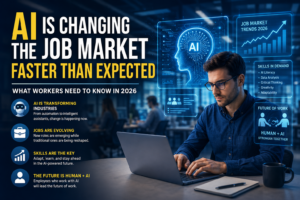
Artificial intelligence (AI) is no longer a futuristic concept—it’s already reshaping workplaces around the world. From customer service and software development to marketing, finance, and healthcare, AI-powered tools are changing how businesses operate and what employers expect from workers.
While some people worry that AI will replace millions of jobs, many experts believe the bigger story is that AI is transforming jobs rather than eliminating them entirely. Employees who learn to work alongside AI are likely to have a significant advantage in the years ahead. Recent studies also suggest the impact varies widely by occupation, with some entry-level and repetitive knowledge-work roles facing greater disruption while many other jobs evolve instead of disappearing.
Table of Contents
- Why AI Is Changing the Job Market So Quickly
- Industries Feeling the Biggest Impact
- Jobs Most Likely to Change
- The Skills Employers Want in 2026
- How Workers Can Prepare
- What the Future Looks Like
- Frequently Asked Questions
Why AI Is Changing the Job Market So Quickly
Over the last two years, businesses have rapidly adopted AI assistants capable of writing reports, analyzing data, generating images, summarizing meetings, creating software code, and automating repetitive tasks.
Companies are embracing these tools because they can improve productivity, reduce operating costs, and allow employees to focus on higher-value work. Instead of spending hours on repetitive administrative tasks, workers can use AI to complete them in minutes.
According to recent research, many roles are expected to be significantly reshaped over the next few years rather than completely replaced. The fastest-growing organizations are increasingly using AI to boost employee productivity while investing in new skills and training.
Industries Feeling the Biggest Impact
Almost every industry is being affected, but some sectors are changing faster than others.
1. Technology
Software developers now use AI coding assistants to generate code, fix bugs, and write documentation much faster than before.
2. Marketing
Content creation, advertising, SEO, email campaigns, and social media management increasingly rely on AI-powered tools.
3. Customer Service
Businesses are deploying AI chatbots capable of answering customer questions around the clock, reducing response times while allowing human agents to focus on more complex issues.
4. Finance
Banks and financial institutions use AI to detect fraud, analyze risks, automate reports, and assist financial advisers.
5. Healthcare
Doctors and hospitals are using AI to help analyze medical images, improve diagnoses, and reduce paperwork, while keeping healthcare professionals involved in final decisions.
Jobs Most Likely to Change
Artificial intelligence is affecting almost every profession, but that does not mean every job will disappear. In most cases, AI is changing how work is done rather than replacing entire careers. Workers who learn to use AI effectively are often becoming more productive and valuable to employers.
Administrative Assistants
Routine tasks such as scheduling meetings, organizing emails, creating reports, and managing calendars can now be completed with AI-powered assistants. Administrative professionals who combine organizational skills with AI tools will remain highly valuable.
Content Writers and Digital Marketers
AI can generate drafts, suggest headlines, and optimize content for search engines. However, businesses still need human creativity, storytelling, fact-checking, and strategic thinking to produce trustworthy and engaging content.
Software Developers
AI coding assistants help developers write code faster, detect bugs, and automate repetitive programming tasks. Instead of replacing developers, these tools allow them to focus on solving more complex technical problems.
Customer Support Representatives
AI chatbots can answer common customer questions 24/7. Human agents remain essential for handling complex issues, complaints, and situations that require empathy and sound judgment.
Data Analysts
AI can process large datasets in seconds and create visual reports. Analysts who understand data interpretation and business strategy will continue to be in high demand.
The Skills Employers Want in 2026
As AI becomes a standard workplace tool, employers are placing greater value on skills that machines cannot easily replicate.
- Critical thinking and problem-solving
- Creativity and innovation
- Strong communication skills
- Leadership and teamwork
- AI literacy and prompt writing
- Data analysis and digital skills
- Cybersecurity awareness
- Adaptability and continuous learning
Workers who combine technical knowledge with strong interpersonal skills are expected to enjoy the best career opportunities in the coming years.
How Workers Can Prepare for the AI Era
The rapid growth of AI does not mean people should fear technology. Instead, it presents an opportunity to learn new skills and stay competitive.
1. Learn AI Tools
Become familiar with tools such as ChatGPT, AI writing assistants, image generators, and productivity software that can improve your workflow.
2. Keep Learning
Take online courses, earn certifications, and stay updated with the latest developments in your industry. Continuous learning has become one of the most valuable career investments.
3. Develop Human Skills
Creativity, emotional intelligence, leadership, negotiation, and decision-making remain difficult for AI to replicate. These skills will continue to set professionals apart.
4. Build a Personal Brand
Maintain an active LinkedIn profile, showcase your projects, contribute to professional communities, and demonstrate how you use AI to improve your work.
5. Stay Flexible
The job market will continue evolving. Professionals who embrace change and adapt quickly will be better positioned for long-term success.
What the Future Looks Like
Experts believe AI will create new career opportunities even as it changes existing roles. Demand is expected to grow for AI specialists, cybersecurity professionals, data scientists, cloud engineers, AI trainers, prompt engineers, and professionals who can combine industry expertise with artificial intelligence.
Rather than replacing the workforce, AI is likely to become a powerful workplace partner. Employees who understand how to work alongside intelligent tools will have an advantage in productivity, innovation, and career growth.
The future belongs to workers who are willing to learn, adapt, and embrace technology. AI is not just changing the job market—it is reshaping the skills needed to succeed in the modern economy.
Frequently Asked Questions (FAQ)
Will AI replace all jobs?
No. AI is expected to automate certain tasks rather than eliminate every job. Many careers will evolve, requiring workers to develop new skills and use AI as a productivity tool.
Which jobs are safest from AI?
Jobs requiring creativity, leadership, emotional intelligence, critical thinking, and complex decision-making are less likely to be fully automated. Examples include healthcare professionals, skilled trades, educators, managers, and creative professionals.
What AI skills should I learn in 2026?
Learning how to use AI assistants, write effective prompts, analyze data, automate workflows, and understand AI ethics can significantly improve your career prospects.
Can beginners use AI to improve their careers?
Yes. Many AI tools are beginner-friendly and can help with writing, research, coding, presentations, graphic design, and productivity. Learning to use them effectively can make you more competitive in today’s job market.
Conclusion
Artificial intelligence is transforming the global workforce at an unprecedented pace. While some routine tasks are becoming automated, AI is also creating new opportunities for professionals who are willing to learn and adapt. The most successful workers in 2026 will not be those who compete against AI, but those who know how to work alongside it.
Whether you’re a student, job seeker, freelancer, or business owner, now is the time to build digital skills, stay informed about emerging technologies, and embrace lifelong learning. AI is changing the job market faster than expected—but with the right mindset and preparation, it can become one of your greatest career advantages.
Enjoyed this article? Follow PulseHubTV for the latest updates on artificial intelligence, technology, cybersecurity, remote jobs, cryptocurrency, gadgets, and digital innovation. Share this article with friends and colleagues to help them prepare for the future of work.
About The Author