What to Check Before Buying a Foldable Phone in 2026
Editor’s Note: Foldable phones have become more sophisticated, with larger inner displays, improved multitasking and premium materials. However, they also introduce buying considerations that traditional smartphones do not. This guide explains what to check before spending money on a foldable phone in 2026.
A foldable phone can give you the convenience of a regular smartphone and the larger screen of a small tablet in one device. You can use the outer screen for everyday tasks, then open the phone to read documents, watch videos or work with two apps at once.
That flexibility sounds appealing. But foldable phones often cost more than conventional smartphones, and their moving hinges and flexible displays deserve careful consideration.
Before choosing a model, look beyond the design and advertised specifications. You should also consider durability, repair costs, battery performance, software support and whether you will actually use the larger screen.
Quick Answer: What Should You Check First?
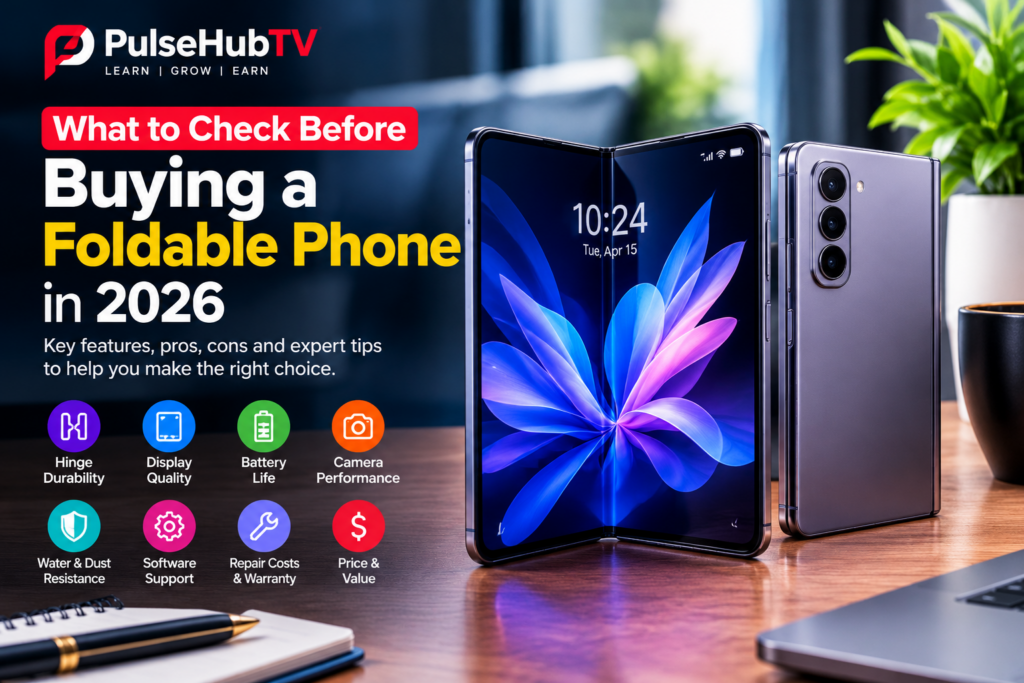
Before buying a foldable phone, compare these eight things:
- Hinge durability and the manufacturer’s warranty.
- Inner and outer display quality.
- Resistance to water, dust and everyday wear.
- Battery life and charging speed.
- Camera performance.
- Software updates and multitasking features.
- Repair costs and local service availability.
- Total price compared with a conventional flagship phone.
The best foldable phone is not necessarily the one with the biggest display. It is the one that fits your daily routine and offers enough practical value to justify its price.
1. Check the Hinge and Overall Build Quality
The hinge is one of the most important parts of a foldable phone. It allows the device to open and close, so its design affects how the phone feels and functions over time.
A good hinge should open smoothly and hold the screen in its intended positions. You should also check whether the manufacturer provides clear guidance about handling the device and maintaining its folding mechanism.
For example, Apple’s iPhone Duo uses a titanium foldable design and a hinge engineered from more than 100 components. Samsung’s latest Galaxy Z Fold lineup also emphasizes improvements to its folding hardware and construction.
Those specifications describe the manufacturers’ designs, but they do not prove how a device will perform after years of personal use.
If possible, handle the phone in a reputable store before buying it. Open and close it gently, check the alignment and inspect the frame for any visible gaps or damage.
Buying tip: Never force a foldable phone shut or open it against resistance. Follow the manufacturer’s instructions rather than treating it like an ordinary handset.
2. Inspect Both Displays Carefully
Foldable phones usually have two displays: an outer screen for quick tasks and a larger inner screen for more immersive use.
The outer display matters because you may use it more often than you expect. Check whether its size and shape make typing, reading messages and browsing comfortable.
The inner display deserves even more attention. Look for clear text, good brightness, responsive touch controls and comfortable viewing angles.
You should also understand that a folding display is different from a traditional glass smartphone screen. The folding area may remain visible, and the surface may feel different from the rigid glass on a conventional phone.
Before buying, ask about the manufacturer’s care instructions, screen protector policy and repair process. Do not remove a factory-installed protective layer unless the manufacturer specifically permits it.
What to check in a store
- Open a white page and look for unusual marks or discoloration.
- Scroll through text to check touch responsiveness.
- Test the outer screen with your usual apps.
- Look at the folding area from different angles.
- Check whether the screen is comfortable to use in bright light.
3. Understand Water and Dust Resistance
Water resistance and dust resistance are not the same thing. A phone may be rated to withstand certain water exposure without being designed to keep fine dust away from every internal component.
Always check the exact protection rating of the model you plan to buy. Do not assume that every foldable phone has the same level of protection.
For example, Apple’s official iPhone Duo specifications list an IP68 rating. However, the meaning of that rating depends on the manufacturer’s test conditions. It should not be treated as a guarantee against every type of liquid exposure or damage.
Also, water resistance can diminish as a device ages or suffers damage. Avoid deliberately submerging your phone, even if its specifications include a water-resistance rating.
If you work in dusty environments, spend time outdoors or frequently use your phone near water, make durability a major part of your decision.
4. Compare Battery Life and Charging
A large folding display can be useful, but you need enough battery capacity to support your daily activities.
Battery life depends on several factors, including screen brightness, mobile signal strength, gaming, video streaming, background applications and how frequently you open the inner display.
Do not rely on battery capacity alone. A larger battery does not automatically mean longer real-world battery life.
Instead, look for independent battery tests that explain their testing conditions. Compare screen-on time, video playback, charging speed and standby performance when that information is available.
Think about your own routine, too. Someone who mainly sends messages may have different needs from someone who spends hours editing documents, using navigation or playing games.
Finally, check whether a charger is included, which charging standards are supported and how much compatible charging accessories cost in your market.
5. Check the Cameras Before Paying a Premium
Some foldable phones offer advanced camera systems, but their photography performance can vary considerably by model.
Check more than the megapixel count. Sensor size, image processing, stabilization, autofocus and low-light performance all affect the final result.
If you frequently photograph children, pets, sports or moving subjects, look for reliable autofocus and shutter performance. If you record videos, compare stabilization, microphone quality and available recording modes.
The outer and inner displays can also create different shooting opportunities. Some foldables let you preview a photograph on the outer screen while using the main cameras.
However, do not assume that a premium foldable automatically has a better camera than a similarly priced conventional flagship. Compare actual sample photos and independent reviews before deciding.
6. Evaluate Software Updates and Multitasking
A foldable phone should do more than open into a larger screen. Its software should make that screen useful.
Check whether your preferred applications support the device’s display layout. Some apps may stretch across the inner screen, while others may show more information or support side-by-side windows.
Useful features may include:
- Running two applications side by side.
- Moving content between supported applications.
- Resizing application windows.
- Using a video call while viewing documents.
- Taking notes while reading or browsing.
Software support is equally important. Find out how long the manufacturer promises operating-system and security updates for the exact model.
Also check whether the phone receives updates in your country and whether important features require a particular account, language, subscription or network provider.
If you plan to keep the phone for several years, update support should be part of your value calculation.
7. Research Repair Costs and Warranty Coverage
Repair costs are one of the most important considerations when buying an expensive foldable phone.
Flexible displays and folding mechanisms can be costly to repair. A damaged inner screen may cost considerably more to replace than the screen on a budget smartphone.
Before paying, ask the seller or manufacturer about:
- Official screen replacement costs.
- Hinge repair availability.
- Warranty exclusions for accidental damage.
- Whether liquid damage is covered.
- Availability of genuine replacement parts.
- Authorized repair centres near you.
Read the warranty terms carefully. A standard manufacturer’s warranty generally does not mean every accidental breakage will be repaired for free.
If you live in a market where authorized foldable-phone repairs are difficult to access, consider the extra cost and inconvenience before buying.
8. Compare the Total Price With a Regular Flagship
Foldable phones are premium products, but the higher price only makes sense if the extra features benefit you.
Compare the foldable model with a conventional flagship phone that offers similar performance, camera quality and software support.
Include the cost of protective accessories, charging equipment, insurance if available and potential repairs. Also check the manufacturer’s warranty and the seller’s return policy.
For buyers in Nigeria, verify the exact model number, network compatibility, eSIM or physical SIM support, warranty coverage and the seller’s reputation. Imported models may differ in supported features and service arrangements.
Do not choose a device based solely on an unusually low online price. Confirm that the product is genuine, understand the return terms and check whether the seller can provide a valid receipt.
Who Should Buy a Foldable Phone?
A foldable phone may be a good choice if you regularly read documents, multitask, edit content, view spreadsheets or enjoy having a larger screen without carrying a separate tablet.
It may also appeal to people who want a compact device that opens into a larger viewing area.
However, a conventional smartphone may be the better purchase if you mainly use messaging, social media, calls and casual photography.
You may also prefer a regular flagship if you want to minimize repair costs, avoid a visible folding crease or prioritize the best camera performance for your budget.
Foldable Phone Buying Checklist
Before completing your purchase, use this checklist:
- Confirm the exact model and storage capacity.
- Inspect the hinge and both displays.
- Read the official durability and care instructions.
- Compare independent battery and camera tests.
- Check software-update commitments.
- Confirm warranty coverage and repair prices.
- Verify network and SIM compatibility.
- Compare the total cost with conventional alternatives.
Frequently Asked Questions
Are foldable phones worth buying in 2026?
They can be worth buying if you will regularly use the larger display for reading, multitasking or productivity. However, the higher purchase price and potential repair costs mean they are not the best choice for every user.
Do foldable phones break more easily than regular phones?
The answer depends on the model, construction, handling and type of damage. Foldable phones contain moving components and flexible displays, so buyers should carefully review durability information and repair options rather than assume they are as resistant as conventional phones.
Is the crease on a foldable screen normal?
A visible crease can be a normal characteristic of a folding display. Its visibility varies by device and viewing conditions. Inspect the display in person if possible, and seek service if you notice new damage or unusual screen behaviour.
Can I use a foldable phone in the rain?
That depends on the exact model and its protection rating. Check the manufacturer’s instructions and avoid assuming that water resistance makes the device waterproof in every situation.
Are foldable phones good for gaming?
The larger screen can make supported games more immersive. However, gaming performance also depends on the processor, cooling system, battery, touch response and how well each game supports the display layout.
Should I buy a foldable phone or a tablet?
Choose a foldable phone if you want one device for calls, messaging and a larger screen. A conventional phone and separate tablet may provide better value if you rarely need a large screen while travelling.
Final Thoughts
Foldable phones offer a different way to use a smartphone, but their design is only one part of the buying decision.
Before choosing one, compare display quality, hinge construction, battery performance, software support, repair costs and the total price. These factors can make a bigger difference to long-term satisfaction than a flashy launch presentation.
If you will use the larger display regularly and can comfortably afford the device, a foldable phone may be a worthwhile upgrade. If you mainly need a reliable phone for everyday tasks, a conventional flagship or mid-range model could be the smarter purchase.
Before buying a foldable phone in 2026, check the hinge, inner display, durability rating, battery tests, software support and repair costs. Choose the device for the features you will actually use—not simply because it folds.
Official Resources
- Apple iPhone Duo technical specifications
- Samsung Galaxy Z Fold8 Ultra specifications
- Apple Support
- Samsung Support
Share This Guide
Know someone considering a foldable phone? Share this guide to help them compare the important features before buying.
About PulseHubTV
PulseHubTV publishes practical guides covering technology, gadgets, artificial intelligence, business, finance and digital trends. Our goal is to help readers understand their options and make informed decisions.
About The Author